Amber ambition: Salisbury leads the way on animal-friendly lighting
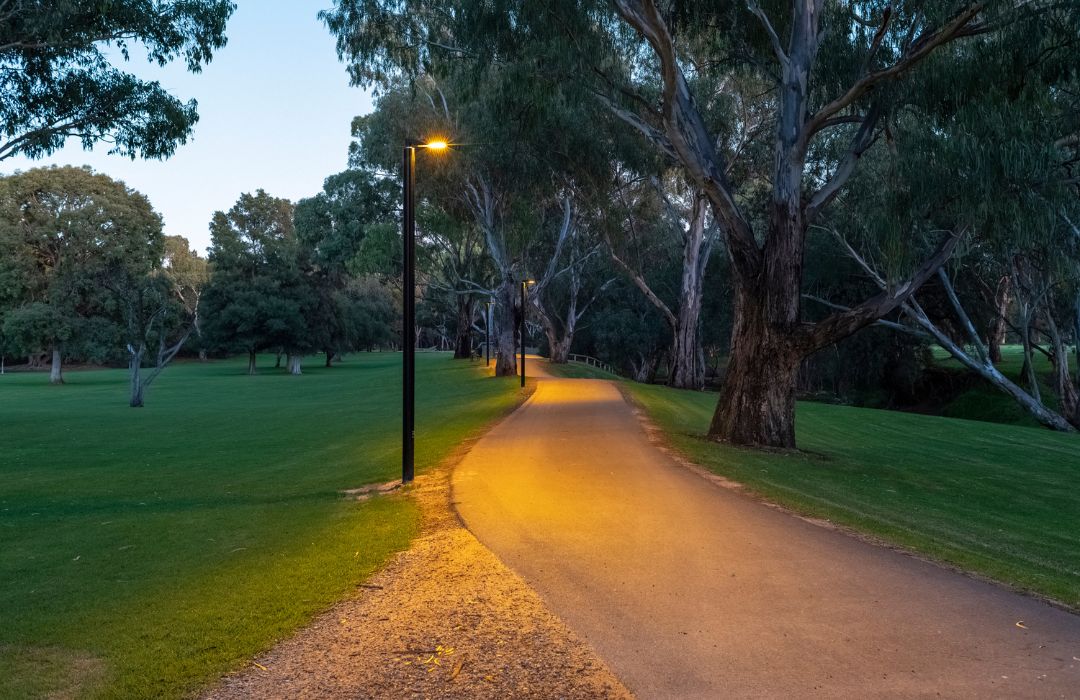
In a quiet stretch along the Little Para River Trail in Adelaide’s north, a groundbreaking project is quietly lighting a path forward for sustainable urban design.
Through a national-first ecological study – conducted in partnership with University of Melbourne and lighting manufacturer WE-EF Lighting – the City of Salisbury has demonstrated the huge benefits a unique type of LED street lighting, known as PC Amber, has for both nocturnal wildlife and the community.
Over a five-month period, acoustic monitoring and pedestrian data was collected across three local parkland sites – an area lit with warm white LED lights, a section illuminated by PC Amber lighting, and an unlit control site – to assess how different types of lighting impacted both animal and human behaviour.
The findings were surprisingly illuminating, according to City of Salisbury Energy and Lighting Specialist Michael Pavlovich.
“PC Amber lighting – which is short for Phosphor Converted Amber – had no observable negative impact on local wildlife and closely mimics the natural conditions of unlit areas,” he says.
“In contrast, standard white LEDs disrupted nocturnal animal behaviour by blocking out moonlight, which they use to regulate their internal body clocks.
“Just like humans follow the sun, many nocturnal animals sync their biological circadian rhythms to the moon. The blue light in regular LEDs masks and interferes with those moon phases, whereas PC Amber doesn’t – making it much less disruptive and intrusive to wildlife.”
Along with the now proven environmental benefits for local animals, the use of PC Amber lighting along the Little Para River Trail has also had a transformative, positive impact on how visitors interact with the space.
Before installation, the shared-use pedestrian and cycle path saw modest use, particularly at night. After the amber lighting went in, foot and bike traffic surged – increasing by more than 400%.
“Cyclists were some of the first to report how good the new path felt,” Michael recalls. “They told us it was immediately clear they’d entered a different, safer space. That was exactly the effect we were going for.
“It’s not about blasting people with light. It’s about using just enough in the right way.”
Michael says the use of amber lighting to illuminate trails in parks and reserves doesn’t just support wildlife and people – they’re also a better financial and environmental investment.
“Each hardwired amber light costs about $72 per year to run and maintain compared to a $254 annual cost for solar lighting, which can be prone to ongoing maintenance and battery issues,” he explains.
“Solar lights might seem free to run, but when a tree shades a panel or a battery fails, you’ve got a costly maintenance visit on your hands. These amber lights are an absolute bargain.”
The new system also used fewer poles, made from lighter composite fibre, and less wiring than originally planned.
The lower wattage of PC Amber LEDs meant the number of lights needed was reduced from 72 to 68, and only three power supply points were required instead of four – delivering considerable savings for the council.
“The light heads also have DALI controllers and daylight sensors, so they self-adjust,” Michael says. “It means we don’t need to send someone out to change settings twice a year for daylight saving. That adds up.”
The success of the Little Para River Trail has already influenced City of Salisbury’s broader approach to public lighting – and elsewhere, interest is also growing.
Other Adelaide metropolitan councils are exploring similar upgrades for local sites, with many visiting Salisbury for night-time tours to see the difference firsthand.
For City of Salisbury Mayor Gillian Aldridge OAM, this kind of project aligns perfectly with the council’s digital approach, which looks to use technology to enhance community wellbeing and service delivery.
“I’m incredibly proud that Salisbury is leading the way in lighting design that supports both people and wildlife,” Mayor Aldridge said.
“It’s the kind of forward-thinking, collaborative work that reflects our values as a council, and we’re thrilled that other councils are now looking to follow our lead.”
While the project was never intended to be a headline-grabber, it’s become a replicable case study for how councils across South Australia can integrate innovation and sustainability when it comes to lighting their parks and reserves.
It’s also been a major professional highlight for Michael during his 10 years working at City of Salisbury.
“This was a trial for us and it's great that my Team Leader Craig Johansen and the council had faith and gave us the go-ahead to give it a try and see if it works,” he says.
“We didn’t know what was going to happen – but the results speak for themselves.”