Art in place: How creative capital works are transforming Tea Tree Gully
Tucked into Adelaide’s leafy north-eastern suburbs, the City of Tea Tree Gully is quietly reshaping the way local government integrates public art with major capital works.
No longer relegated to stand-alone sculptures or murals tacked onto the end of a project, art in the council area is becoming something much more: a tool for placemaking, a source of civic pride and a way of inviting the community to co-create the spaces they live, work and play in.
At the heart of this transformation are two passionate council leaders – Public Art Project Coordinator Carly Didcote and Manager Project Management Office Greg Salmon.
With decades of combined local government experience and a shared love for Tea Tree Gully as residents, the pair are proving how combining public infrastructure and art can generate stunning results.
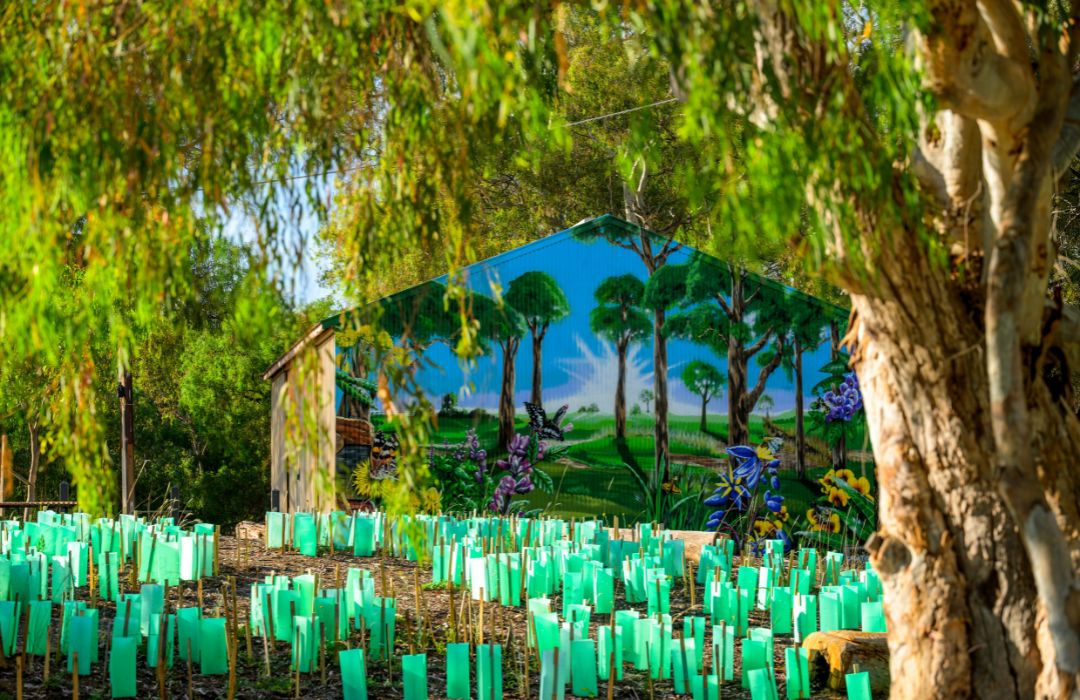
On a sunny morning at Kingfisher Reserve, located a short drive from Tea Tree Gully library and main office, Greg and Carly sit on a park bench nestled amongst the canopy of gum trees. Adjacent them is a striking mural splashed across the side of the local Lions Club shed.
It’s a vibrant piece featuring native butterflies, bees and plant life – commissioned and funded by the Lions themselves, but co-designed with council to align with broader themes of biodiversity and environmental education.
“We’re always asking: what’s the story here? What makes this site unique? Is it the nature, the history, the people? Then, we try to reflect that,” Carly says.
“The Lions approached us wanting something on the shed. They funded it, and we worked together to make sure it matched what the council was already doing with biodiversity messaging. It was a genuine co-design process.”
The result, brought to life by local artist Marciano Arents of Senman Creations, is functional, emotive and unmistakable.
For Greg, who previously led projects at the City of Marion and Playford, the inspiration for this art-first approach came from his time managing a city activation team focused on integrating art into capital works.
When he arrived at Tea Tree Gully around four years ago, he saw an opportunity to embed that thinking into how the council approached future infrastructure developments.
“Every project is about creating a sense of place,” Greg explains. “We don’t just pick a cookie cutter design off the shelf and plonk it down. It has to fit the area.
“Rather than tacking art on the end of a project, it's been very much integrated from the beginning. It should feel seamless as part of the design.”
Carly brings a different but complementary background. With nearly 30 years in youth and community development – including time at City of Port Adelaide Enfield – her focus is on building community ownership.
Originally hired into a youth development role at Tea Tree Gully 18 years ago, she transitioned into public art just as the council was forming a new Project Management Office.
“Community connection has always been my focus,” Carly says. “When you involve people in the process – from school groups to Men’s Sheds to historical societies – they feel a sense of pride. And that changes the way they interact with the space.”
The impact has been immediate and tangible. One of the most recent visible successes has been a series of custom-designed toilet wraps featuring professional-quality photographs of native flora and fauna – each one taken by a member of the Tea Tree Gully Photography Club.
The images are beautiful, but they also serve as educational tools. The toilet block at Kingfisher Reserve is emblazoned with a stunning blue Superb Fairywren, which is local to the area and serves as a topic of conversation and learning for local school groups who visit on day excursions.
Toilet facilities at other locations across the council area – including Solandra Reserve, Edinburgh Reserve, Cobbler Creek Reserve and the Linear Park Trail – are also adorned with imagery of native wildlife.
While enhancing these spaces, the artwork has also acted as a subtle deterrent to would-be vandals – an unexpected but welcomed bonus.
“We’ve actually seen a reduction in vandalism at sites where the artwork has gone in,” Carly explains. “People seem to be less likely to damage something they feel connected to.”
Feedback has been overwhelmingly positive – not just from residents, but also community groups, elected members and even other councils wanting to learn more and potentially replicate the success.
For Tea Tree Gully Mayor Marijka Ryan, it’s reassurance for her and other elected members the council is headed in the right direction with its approach to art and public spaces.
“What makes these projects so special is the sense of ownership they create,” Marijka says.
“When locals contribute their photos, ideas or stories, it’s no longer just a council initiative – it becomes something the whole community feels proud of. That pride is what gives these spaces life.”
Greg says by making art specific to place, it resonates more deeply with those living in the area.
“The pieces that always go well are the ones where people look at it and go, ‘I get it. That’s us’,” he says. “If it’s random, you risk it not landing with the community.”
Looking ahead, City of Tea Tree Gully is already working on a suite of new projects.
At the nearly complete $9.2 million gymnastics facility at Banksia Park, three stainless steel polygon-style sculptures – co-designed by artist Claude Portelli, Tea Tree Gully Gymsports and council staff – will soon be incorporated into the façade.
Inspired by local athletes, the stylised figures capture mid-gymnastic movement, frozen in time.
“They’re designed in this origami-style, folded stainless steel,” Carly says. “They’ll look amazing lit up at night. It's exciting knowing that the gymnasts are actually now living art in a way, so we can't wait until they're built.”
Even playgrounds are being reimagined. At Coulls Reserve in Highbury, new equipment will be themed around the old flour mill that still stands nearby on the River Torrens.
Sand play, mosaic motifs and storytelling panels will help children connect with local heritage while they play.
“We always ask ourselves: what would a kid call this place?” Greg says. “We want kids to know it as ‘the mill playground’ or ‘the train playground’ – spaces that stick in people’s minds because they’re unique and easily identifiable.”
At Vista Reserve, the new half-court basketball area features a vibrant in-house design of a grey currawong bird, creating a unique focal point.
The examples are endless, no matter which part of the council area you visit.
For Carly and Greg, the melding of art and construction in Tea Tree Gully isn’t just about putting images on walls or floors – it’s embedding creativity and locality into the fabric of the city for generations to come.
“That's what it's all about for me – creating that sense of place, working in the council I live in, I've grown up in,” Greg says. “I want every project to be connected to Tea Tree Gully.”
Carly agrees and is looking forward to what opportunities lay ahead.
“Public art can be so powerful,” Carly says. “And for me, it’s still a journey. I’m learning all the time and there are so many experienced Public Art Officers out there whose work has been pivotal in integrating art into the public realm.
“What excites me most is seeing the pride people feel when they see themselves reflected in the places they love – and I’m proud to be playing my part.”